
Home + DIY
 Leroy Merlin
Drove $651K in attributed gross sales with shoppable customer content
$651KAttributed gross sales
Revenue in the customer’s own GA4
What changed
- $651KAttributed gross sales11.3M ZAR over 10 months, per Leroy Merlin GA4
- Both upConversion + AOVLift on PDPs carrying UGC, post-launch
- 7,488Add-to-carts from the widgetProducts added to cart straight from customer content
- Widget impressions
- 188M
- Visitors reached
- 49.1M
- Click rate
- 0.14%
- Live galleries
- 31
- UGC collected
- 1,900+
Leroy Merlin South Africa put real customer content next to the buying decision on product and homepage modules. Over a 10-month window the widgets carried $651K (11.3M ZAR) in attributed gross sales in its own GA4, with conversion and AOV both up on pages running UGC. Since going live in August 2024 the galleries have been shown 188M times, and shoppers have added 7,488 products to cart straight from customer content.
About Leroy Merlin
Leroy Merlin South Africa sells home-improvement, building, garden and decor ranges in its stores and online at leroymerlin.co.za. Before Idukki it ran customer content on Bazaarvoice.
The problem
On a home-improvement catalogue, studio shots rarely answer the question shoppers actually have: how does this look and hold up in a real home? That gap shows up as hesitation on the product page and value left in the cart.
What they set up
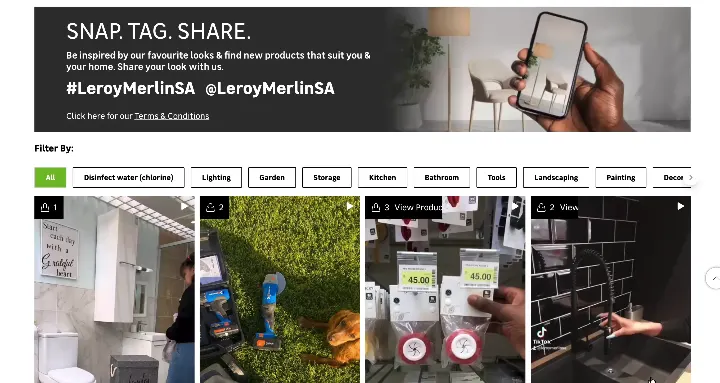
- 1Collected and rights-cleared customer photos and videos, then surfaced them in shoppable galleries on high-intent product and homepage modules.
- 2Tagged products onto the UGC so a shopper could move from inspiration to cart in a click, without leaving the page.
- 3Ran a SNAP-TAG-SHARE inspiration wall and monthly competition entries to keep fresh content flowing from real customers.
- 4Reconciled cart and order events back to each widget so the revenue contribution was attributed in GA4, not assumed.
The results
Attributed gross sales: $651K (11.3M ZAR over 10 months, per Leroy Merlin GA4). Conversion + AOV: Both up (Lift on PDPs carrying UGC, post-launch). Add-to-carts from the widget: 7,488 (Products added to cart straight from customer content). Cart value from the widget: R14.6M (Value of those add-to-carts: buying intent, not revenue).
Why it worked
Home improvement is a show-me category. A shopper looking at a paint, a tile or a garden set wants to see it in a real home, and the galleries put exactly that next to the add-to-cart button. The content kept coming from three always-on channels (QR codes, the post-purchase email and a social upload on the product page), so the galleries never went stale: 31 of them are live today, from the homepage to category edits like Bathroom, Garden & Landscaping and Kitchen & Storage.
How it’s measured
- Evidence
- Revenue in the customer’s own GA4
- Method
- Gross sales attributed to the Idukki widgets in Leroy Merlin’s own GA4, with cart and order events reconciled back to each widget. Add-to-carts, cart value and reach from Idukki widget analytics.
- Window
- 10 months for GA4 revenue; lifetime for the widget figures; 18 months for the UGC collected
- Source
- Leroy Merlin GA4 (revenue); Idukki production analytics (widget figures); Idukki platform records (UGC collected)
- What it does not prove
- Conversion and AOV are reported as up on product pages carrying UGC; the size of that lift is not published. The store has no Idukki checkout tracking, so proven revenue is measured in GA4 instead.
Stack
- Idukki shoppable galleries
- Product tagging
- SNAP-TAG-SHARE wall
- GA4 revenue attribution
Want a result like this?